What makes a fintech defensible: Between the Seams by Stitch, with Charley Ma
On Between the Seams, Stitch CEO Kiaan Pillay talks to Charley Ma of Pathlight Ventures about his path through Plaid, Ramp and Alloy into venture capital and why he believes the businesses built to last aren't the ones that moved first, but the ones that executed better than anyone could copy. The conversation covers product-market fit, the danger of picking the wrong customer, and how AI is changing what counts as a defensible fintech business.
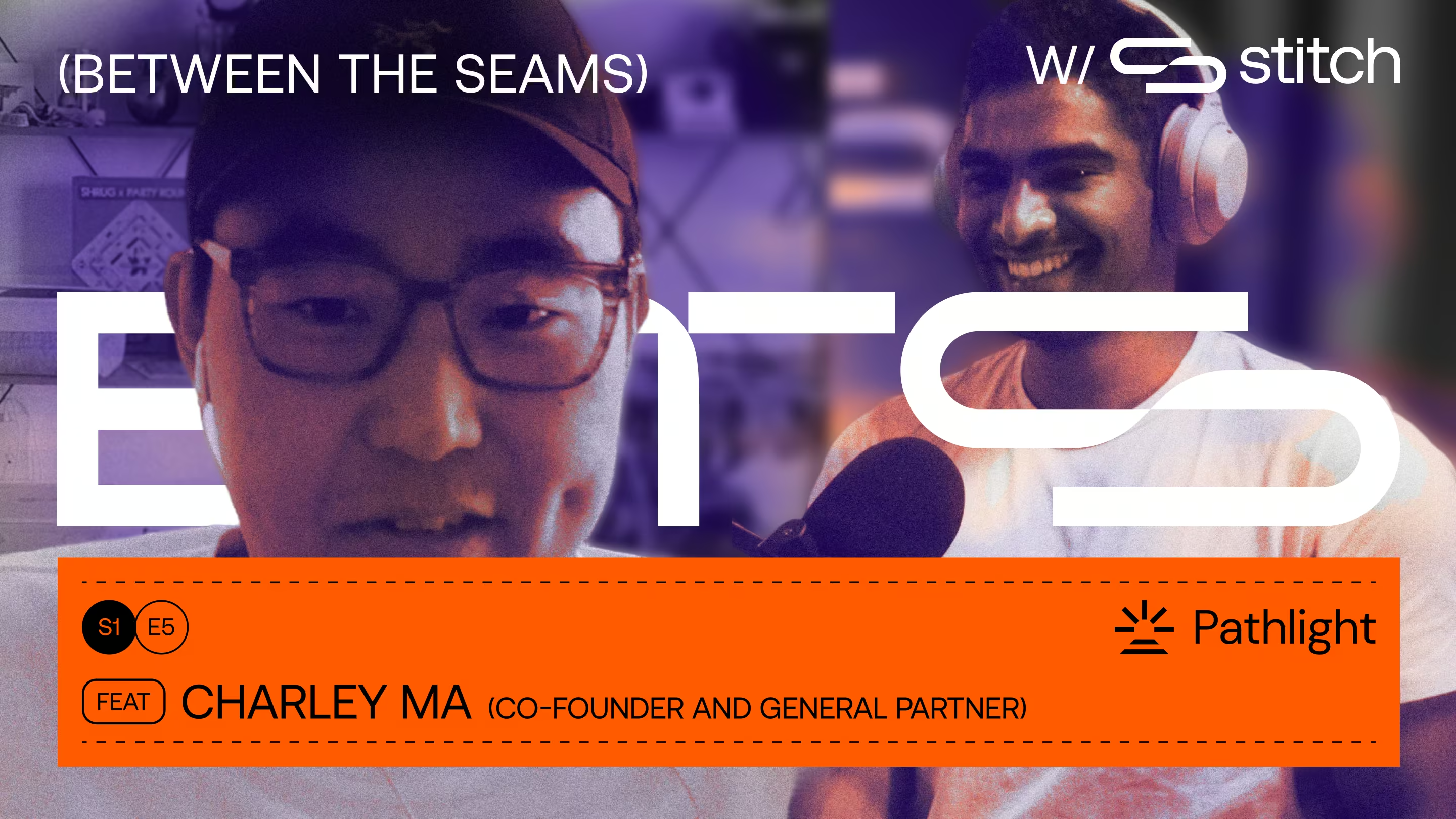
Charley Ma has spent his career inside some of fintech's most consequential companies before switching to the other side of the table as an investor.
In the fifth episode of Between the Seams, Stitch CEO Kiaan Pillay sits down with the co-founder and general partner of Pathlight Ventures to trace a path that runs from JP Morgan's early blockchain desk through Plaid, Ramp and Alloy, and into venture capital. The conversation covers some of the core signals for product-market fit, why picking the wrong customer can sink a company long before anyone notices and why Ma thinks AI has changed what counts as a defensible business.
From behind a blockchain desk to backing founders
Ma joined JP Morgan straight out of university with no fixed plan beyond wanting a job, and landed on a small R&D team tasked with finding new technology across the bank's operations. Payments caught his attention, largely because so much of it still ran on legacy infrastructure. That curiosity led him to Bitcoin and blockchain strategy around 2011 and 2012, years before the topic had any mainstream credibility inside a bank.
From there, he moved to Plaid as an early employee focused on sales and new business. He then moved to Ramp, when he was first introduced to Kiaan and the Stitch team, in whom he later invested.
Ma then moved to Alloy as head of growth. This happened during the pandemic, when digital identity verification became a priority for every financial institution overnight. Angel investing came next, driven by a simple instinct: he wanted exposure to founders solving interesting problems without committing to one himself. That eventually became Pathlight Ventures, the fund he now runs with co-founder Mahdi Raza.
Product-market fit looks like customers pulling, not you pushing
Plaid's early years were unglamorous by Ma's own account. The team underpriced the product, restructured the API because it hadn't been built for proper packaging, and made calls on hiring that they later reversed. Yet usage kept climbing regardless.
"When you have a product and market, and customers are just pulling it out from you in spite of all the dumb stuff you're doing, that's true product-market fit," Ma says.
Fundraising was harder than the eventual outcome suggests. Investors dismissed the market as too small, since only a handful of fintech companies existed in the US at the time to sell into. That scarcity became an accidental advantage: once Plaid secured funding, few investors wanted to back a rival, which left Plaid as close to the only option in its category. "The only way Plaid works is if we sign every single fintech company that exists," Ma explains, describing a business that only made sense once a much larger wave of fintech founders arrived to build on top of it.
Ramp's bet on the customer nobody else was serving properly
Ramp told a different story. By the time Ma joined, the corporate card market already had entrenched players, including a well-funded, fast-moving competitor in Brex. Conventional wisdom said the space was won.
Digging into customer feedback revealed a gap: founders liked their existing cards, but finance teams weren't using them. Incumbents had grown quickly without building the reporting, controls and workflows that a CFO or controller actually needs to roll a card out company-wide. Ramp built for that overlooked buyer while pairing it with financial infrastructure that hadn't existed a few years earlier. Ma is candid about the difference in execution required. "At Plaid I feel like we did everything wrong," he says. "At Ramp, it was: we're doing something wrong, we have a couple of days, we have to go fix it."
Choosing the wrong customer is one of the few genuinely irreversible mistakes
Asked what decisions can permanently damage an early-stage company, Ma returns to a single theme: knowing precisely who the product is for. He recalls a founder who celebrated signing a Fortune 500 logo, only for it to emerge that the contract was worth 1,000 US dollars a month. No sales motion built around that pricing could ever scale, regardless of how strong the customer's name looked on a website. "If you pick the wrong ICP, or you build a product that doesn't deliver enough value for what the sales cycle costs, you can't deny the gravity of a business model and a product," he says.
Pillay recognised the pattern from his own early days at Stitch. "We had a lot of really good logos very early on at Stitch, South African household names, but they were all paying us around 500 rand a month," he says. "It looked good on paper. Really, the unit economics didn't make sense. That was one of the big turning points for us."
Treating a new region as one market is a common and costly mistake
The conversation turns to geographic expansion, an area both founders have learned the hard way. Ma points to Plaid's move into Canada, where a head of sales had to explain that Canadian buyers rarely say no outright, leading to pipeline that looked healthy for months before eventually going nowhere. He also flags the habit of treating an entire continent as a single buyer, the mistake many US companies make when they view the EU as one market rather than dozens of distinct ones. "Expanding out region by region is actually non-trivial," he says. "It's almost like you're building a completely brand new company."
Pillay has seen the same dynamic play out across Africa. At a previous pan-African identity verification business, he found sales teams stereotyping West and East Africa in near-identical ways to Ma's Canada story. "West Africans are very direct, they'll tell you yes or no quickly," he says. "East Africans will have the best conversations for six months and just never buy." South Africa, he suggests, tends to sit somewhere between the two.
A fund built to move slower and narrower
Pathlight Ventures positions itself as a generalist fund with four or five thematic areas of focus: safety and security across the physical and digital world, health and wealth, accelerated computing infrastructure, and modernising frontline SMB and legacy enterprise operations with AI. Rather than spreading capital across 30 to 60 companies the way many seed funds do, Pathlight backs roughly 15 to 20 per fund, which Ma says allows for far deeper involvement with each founder.
Sourcing, in his experience, comes mostly from proactive outreach rather than inbound interest. "VC is the ultimate sales job," he says. "Every morning you have a lead list of founders and companies you want to get in front of. Congratulations, you're an SDR." The strongest conversations, he adds, tend to start when a founder pushes back on something Pathlight has published, rather than simply responding to a stated investment thesis.
Why AI is redrawing the line around a defensible business
Ma is direct about the moats he no longer trusts. Horizontal software with no regulatory complexity, in his view, is exposed to being copied the moment a feature proves popular. Regulated, infrastructure-heavy categories look different. "Anthropic isn't going to buy code payments," he says, using Stitch as his example of a business built on problems that are genuinely hard to replicate, not just hard to imagine.
He also sees the underlying software model shifting. Where a company once had to sell a product, manage the rollout and train a customer's team to realise value, AI agents increasingly deliver the outcome directly. "Before, I had to sell you a piece of software, do change management and teach your team how to use it," he says. "Now I deploy an AI agent into your system and it works, and that's it." The metrics he tracks with founders have moved accordingly, away from usage and engagement dashboards and toward a simpler question: is there a dead obvious return on investment?
For Stitch, operating at the harder, regulated end of payments, spanning card acquiring, payment orchestration and the infrastructure connecting businesses directly to banks and networks, Ma's framing lands close to home. The businesses built to last, on his account, are rarely the ones that moved first. They're the ones that worked out exactly who they were building for, and then executed on it better than anyone else could copy.
FAQs
Who is Charley Ma?
Charley Ma is co-founder and general partner at Pathlight Ventures. Before moving into venture capital, he held early roles at JPMorgan, Plaid, Ramp and Alloy, working across payments, financial infrastructure and identity verification. He discussed his career and investment thesis on Between the Seams, the podcast by Stitch.
What is Pathlight Ventures?
Pathlight Ventures is a generalist venture capital fund founded by Charley Ma and Mahdi. The fund takes a high conviction, low velocity approach, investing in around 15 to 20 companies per fund rather than the 30 to 60 typical of many seed funds.
What investment themes does Pathlight Ventures focus on?
Pathlight Ventures focuses on four or five broad themes: safety and security across physical and digital environments, health and wealth, accelerated computing infrastructure, and modernising frontline SMB and legacy enterprise operations with AI.
Why did Plaid struggle to raise funding early on?
Investors viewed the US fintech market as too small to justify backing an infrastructure provider. Once Plaid did secure funding, few investors wanted to fund a direct competitor, which left Plaid with limited competition in its category as the fintech sector expanded around it.
What mistake do founders commonly make when expanding into a new market?
Founders often treat an entire region, such as the EU or a continent, as a single homogenous market. Charley Ma argues that buying behaviour, cultural norms and product needs vary significantly even within neighbouring markets, making region-by-region expansion closer to building a new company than replicating an existing one.
How is AI changing what makes a business defensible?
Charley Ma argues that horizontal software products are increasingly easy to copy, while regulated, infrastructure-heavy sectors such as payments and healthcare remain hard to penetrate. He also points to a shift from selling software that requires customer training toward deploying AI agents that deliver a result directly, changing how investors assess return on investment.
Get more insights from industry experts