The SARB’s Arif Ismail on re-engineering South Africa’s payments system
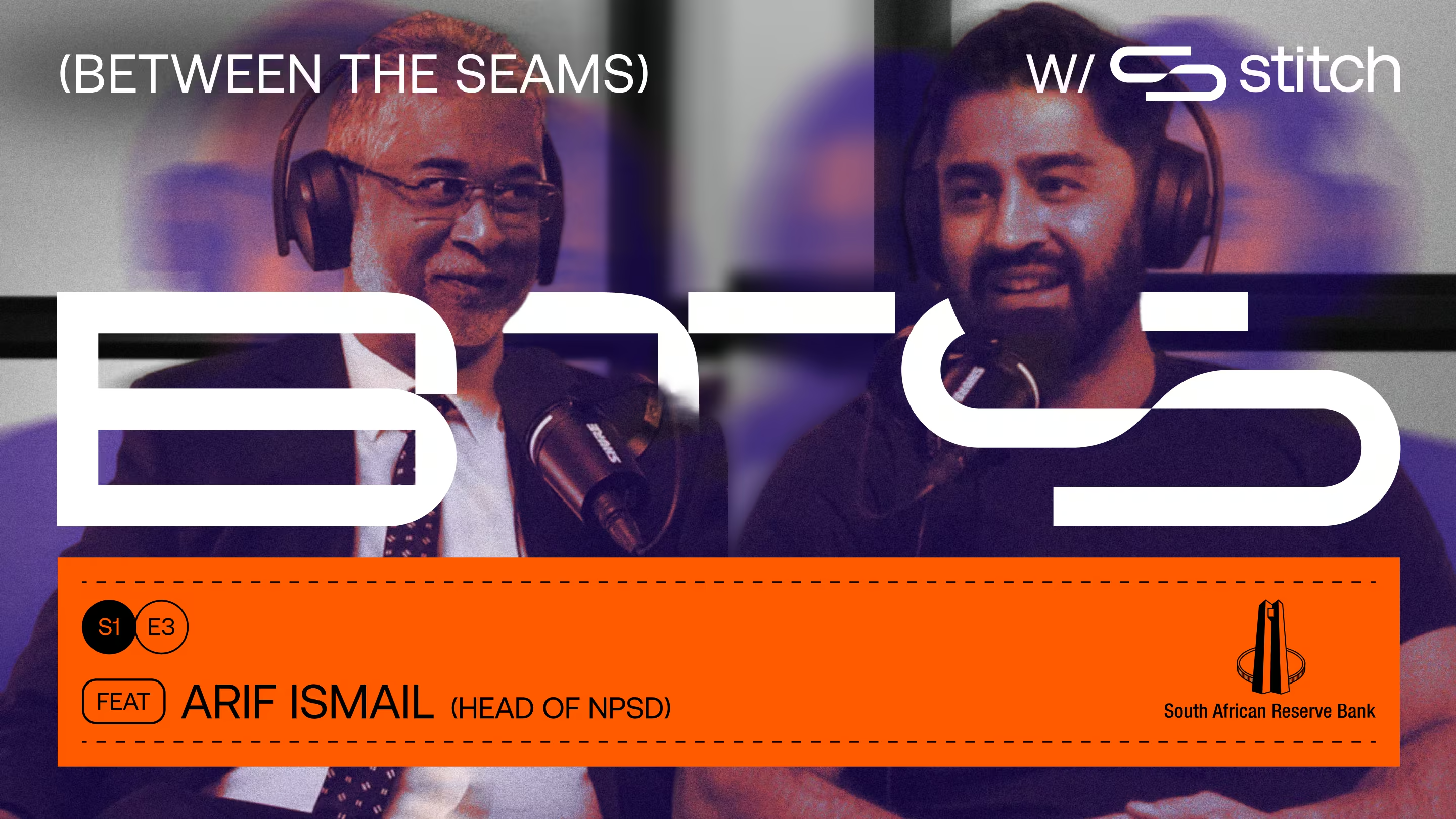
Arif Ismail, Head of the National Payment System Department (NPSD) at the South African Reserve Bank, joins Junaid Dadan on Between the Seams to trace the full arc of South Africa's payment system: how it was built, why PayShap sits at one transaction per capita per month while Brazil's Pix does 33, and what the SARB's Payments Ecosystem Modernisation (PEM) programme is doing to close that gap.
South Africa has had real-time clearing between banks since 2006. Brazil's Pix, which launched in 2020, already processes 33 transactions per capita per month, whereas South Africa's PayShap is at one.
That statistic opened one of the most substantive conversations we’ve had on the Between the Seams podcast yet. Arif Ismail, Head of the National Payment System Department (NPSD) at the South African Reserve Bank (SARB), sat down with Stitch President and Co-founder, Junaid Dadan, to talk through the structural re-engineering currently underway in South Africa's payment system and what it will take to close that gap.
From loading ATMs to overseeing South Africa’s payments system
Arif's entry into payments was as hands-on as it gets: He started in the early 2000s loading cash into ATMs and fixing point-of-sale machines, before moving through Nedbank and then into Absa, where he was part of the team that built the foundational infrastructure South Africa's payment system still runs on today: real-time clearing, card, debit orders and more.
He describes the Absa years between 2004 and 2008 as a golden period. "We built almost every single payment system that South Africa today has. We just didn't know at that stage how cool it was to build payment systems that quickly."
From Absa, he moved to PASA to lead strategy for the national payment system, then joined the SARB as Head of Oversight, before spending four years at the International Monetary Fund (IMF) working on payment system policy, surveillance and technical assistance across advanced and emerging economies worldwide. He returned to South Africa to take on his current role.
Junaid raises the point that regulators who've actually worked inside the systems they govern bring a different quality of judgment. Arif agrees, framing what good regulation requires: understanding both the policy intent and the practical domain, while earning the trust of the industry. "There are always trade-offs between innovation and inclusion and integrity. Folks have to trust that you're going to do what is in the best interest of the national payment system."
How the plumbing works
Arif spends time explaining the mechanics of SAMOS (the South African Multiple Operations System or Switch), the SARB's Real-Time Gross Settlement (RTGS) system and the infrastructure beneath every card payment, EFT and bank transfer in the country. Every day, R584 billion flows through it. "We churn the GDP every 12 days," he says. More than 92% of that value is wholesale – large transactions from commercial banks and the securities and derivatives market. All retail transactions combined account for less than 8% of total value, despite representing the bulk of transaction volumes.
For anything over five million rand, settlement is instantaneous and funds must be confirmed before the instruction executes, eliminating counterparty risk. As Junaid puts it, "All transactions are just promises, and you guys are helping enforce that promise."
Why the SARB is getting closer to the action
For most of the past 30 years, the SARB operated as a regulator at arm's length, setting policy through vision documents while leaving operational infrastructure to the banks and providers like Bankserv, now Pay Inc. Under that structure, the banks both wrote the rules through PASA and owned the infrastructure underneath. The SARB has now taken a stake in Pay Inc, moving directly into the operational layer.
Arif is candid about the tension this creates. "There's nothing wrong with the profit incentive. We want payment system stakeholders to be profitable. But there's obviously a public good interest: cheaper payments, greater efficiency, deeper financial inclusion."
Junaid agrees, pointing out that when the profit objective and the social objective sit in the same hands, they don't always point in the same direction. The SARB's increased stake is designed to rebalance that.
South Africa is not unusual in doing this: India, Brazil and Singapore have all seen their regulators take a more hands-on role at different points, depending on where the system needed pressure applied.
The macroeconomic case for digital payments
Research from the Bank for International Settlements (BIS), the IMF and the World Bank shows that shifting an economy from cash to digital can contribute up to 0.5% or more to GDP. For a country on a low-growth trajectory, Arif argues that's not a marginal consideration.
However, he finds the human argument more compelling than the macroeconomic one. He describes a family member who collects a SASSA grant each month: taking a taxi, standing in a queue, spending time and money to access funds already owed to them. "If we can send transactions at low cost and fast speed, that gives people a better quality of life."
For small businesses, the stakes are equally direct. Delayed settlement means running a working capital cycle just to wait for money already earned. "Time is money. If you don't have the cash flow, how do you pay suppliers?"
A look at payment systems in Brazil and India
Arif is careful not to advocate for copying other markets wholesale, but the numbers from Pix and India's Unified Payments Interface (UPI) are hard to set aside. Brazil reached 33 transactions per capita per month. India's UPI processes roughly 40 billion transactions per month. South Africa is at around 40 million. As Junaid observes, that's a factor of roughly 1,000, even though India's economy is nowhere near 1,000 times the size of South Africa's.
From Brazil's experience, Arif draws three practical lessons. Participation was mandated across the industry with no opt-outs. The business model was deliberately structured to drive adoption on both sides: banks competed for consumers through a single-key account structure, while merchants were offered 28 basis points for signing up businesses that had never transacted digitally, with person-to-person (P2P) transfers set at zero fee. And the early laissez-faire approach to e-money providers generated significant fraud. "You've got to stimulate the fintech sector to come in, but you've got to be careful of the rules of the game," he says.
India's catalyst was different: a government-driven demonetisation push rather than a pandemic response, as was the case in Brazil. Arif asked South Africa: "What catalyst would we need?"
He also highlights a counterintuitive finding from the Brazilian data. When Pix introduced zero-fee P2P transfers, transaction volumes across every payment system, including card, continued to rise. The explanation is that bringing more people into the digital economy generates rich data that supports other financial services, creating value that doesn't show up in per-transaction fees.
What great looks like by 2030
Asked to describe where the payment system should be in five years, Arif sets out three areas of ambition.
- The RTGS needs to be modernised off COBOL and onto a technology stack that can support tokenisation of money and assets, programmability
- T+0 settlement
- and quantum-resistant security.
By 2030, uncompromisingly, we must have a modernised RTGS.
Universal access to real-time payments follows: cheap, fast, secure and available online or offline. Cross-border should also work the same way domestic does. "I should be able to send someone money in Singapore, Thailand, Brazil or Scandinavia the way I send an email." Underpinning all of it is a verified digital identity layer, which the SARB is currently developing under the name PEM Key.
The Payments Ecosystem Modernisation programme
These ambitions sit within the Payments Ecosystem Modernisation (PEM) programme, stood up by the SARB as a direct response to unfinished business from its Vision 2025 goals. Five of the nine goals under that framework remain unachieved, including cheaper transactions, greater efficiency and deeper inclusion. PEM is structured around three workstreams: modernising the RTGS, improving faster payments and building out the digital financial identity infrastructure.
To deliver on this, the SARB is taking on more than 60 new staff within the NPSD alone, drawing on people from across the industry and operating through a hub-and-spoke model that engages banks, fintechs and other participants through formal working groups. Arif is looking to those participants for knowledge and experience, a critical voice and sustained commitment. "We can only do this if we're together as an industry. And South Africa has demonstrated that many times before."
QR codes and closing the card gap
One specific PEM workstream focuses on standardising QR codes across payment rails. Currently, card payments on a physical terminal are the dominant form of digital payment at the point of sale, but as Junaid points out, mobile penetration in South Africa is effectively 100% of the adult population, while card penetration is a fraction of that.
A standardised QR code, scannable from any phone regardless of the payment rail beneath it, would let anyone with a smartphone initiate a digital transaction without needing a card. Arif's view is that card will remain important, but competing alternatives are necessary. The QR programme is focused on interoperability, security and ensuring that a single code can work across multiple rails whether the payment is payer-initiated or payee-initiated.
Cross-border: the longer game
Remittance fees to the Southern African Development Community (SADC) region can exceed 8%, sometimes more than 10%, borne largely by people sending money home who can least afford it. The G20 target is to bring cross-border remittance costs below 3%. The SARB's near-term goal is connecting domestic faster payment systems across SADC through a central hub that processes transactions on an immediate basis.
Beyond the region, conversations are underway with Nexus in Southeast Asia and TIPS in Europe. "The plumbing is being re-engineered right now," Arif says, "and I think it's a wonderful time, not just for domestic payments, but for cross-border payments."
The episode closes with the target Arif says has become a rallying point: moving PayShap from 60 million transactions per month to 500 million, or ten transactions per capita – a tenfold increase.
The full episode is available for watching and listening – learn more about BTS and where to listen here.
FAQs
What is the SARB's role in South Africa's payment system?
The SARB performs three main functions in South Africa's payment system: it operates the Real-Time Gross Settlement (RTGS) system known as SAMOS, which settles all interbank transactions in central bank money; it sets the regulatory and legal framework governing payment systems; and it supervises and oversees the system to ensure stability, efficiency and financial inclusion. The SARB has recently taken a stake in Pay Inc, the central payments infrastructure provider, reflecting a more active operational role than it has historically played.
What is SAMOS and how does it work?
SAMOS stands for South African Multiple Operations System or Switch. It is the RTGS system operated by the SARB, through which all interbank settlement in South Africa ultimately occurs. Every day, around R584 billion flows through SAMOS. More than 92% of that value is wholesale, comprising large transactions from commercial banks and the securities and derivatives market. All transactions over five million rand settle in real time, with funds verified before the instruction executes.
What is PayShap and why is adoption still low?
PayShap is South Africa's faster payments service, built on real-time clearing infrastructure that has existed since 2006. Despite that infrastructure being nearly two decades old, PayShap currently processes around 60 million transactions per month, or roughly one transaction per capita. By comparison, Brazil's Pix processes 33 transactions per capita per month. Low adoption reflects a combination of factors including commercial model design, limited mandated participation and a lack of the catalytic event, such as a pandemic or demonetisation push, that accelerated adoption in Brazil and India respectively.
What is the Payments Ecosystem Modernisation (PEM) programme?
PEM is a strategic programme run by the SARB to modernise South Africa's payment system. It was established in response to five of the nine goals under the SARB's Vision 2025 framework remaining unachieved. PEM is structured around three workstreams: modernising the RTGS system, improving faster payments infrastructure and building a digital financial identity layer known as PEM Key. The programme operates through a hub-and-spoke model involving banks, fintechs and other industry participants through formal working groups.
What can South Africa learn from Brazil's Pix?
Brazil's Pix reached 33 transactions per capita per month within five to seven years of launch. Three factors drove that scale. First, participation was mandated across the financial sector. Second, the business model was designed to create competitive incentives on both the consumer and merchant side, with P2P transfers set at zero fee and merchants offered 28 basis points for signing up businesses new to digital payments. Third, the early approach to e-money providers was too permissive, generating significant fraud, which points to the importance of clear rules for fintech participation from the outset.
What is the #500 target for South African payments?
The #500 target refers to the SARB's ambition to grow PayShap from its current level of around 60 million transactions per month to 500 million — equivalent to ten transactions per capita per month. Reaching that figure would represent a tenfold increase and would bring South Africa significantly closer to the adoption levels seen in Brazil and other markets that have successfully scaled real-time payment systems.
Get the full episode