Between the Seams: Superbalist’s Ashley Martin on building for the next frontier
Superbalist CTO Ashley Martin joins Priyen Pillay on the first episode of Between the Seams to talk about what it takes to build resilient e-commerce infrastructure, why averages are the enemy of great customer experience, and how AI tools are reshaping what's possible for lean engineering teams.
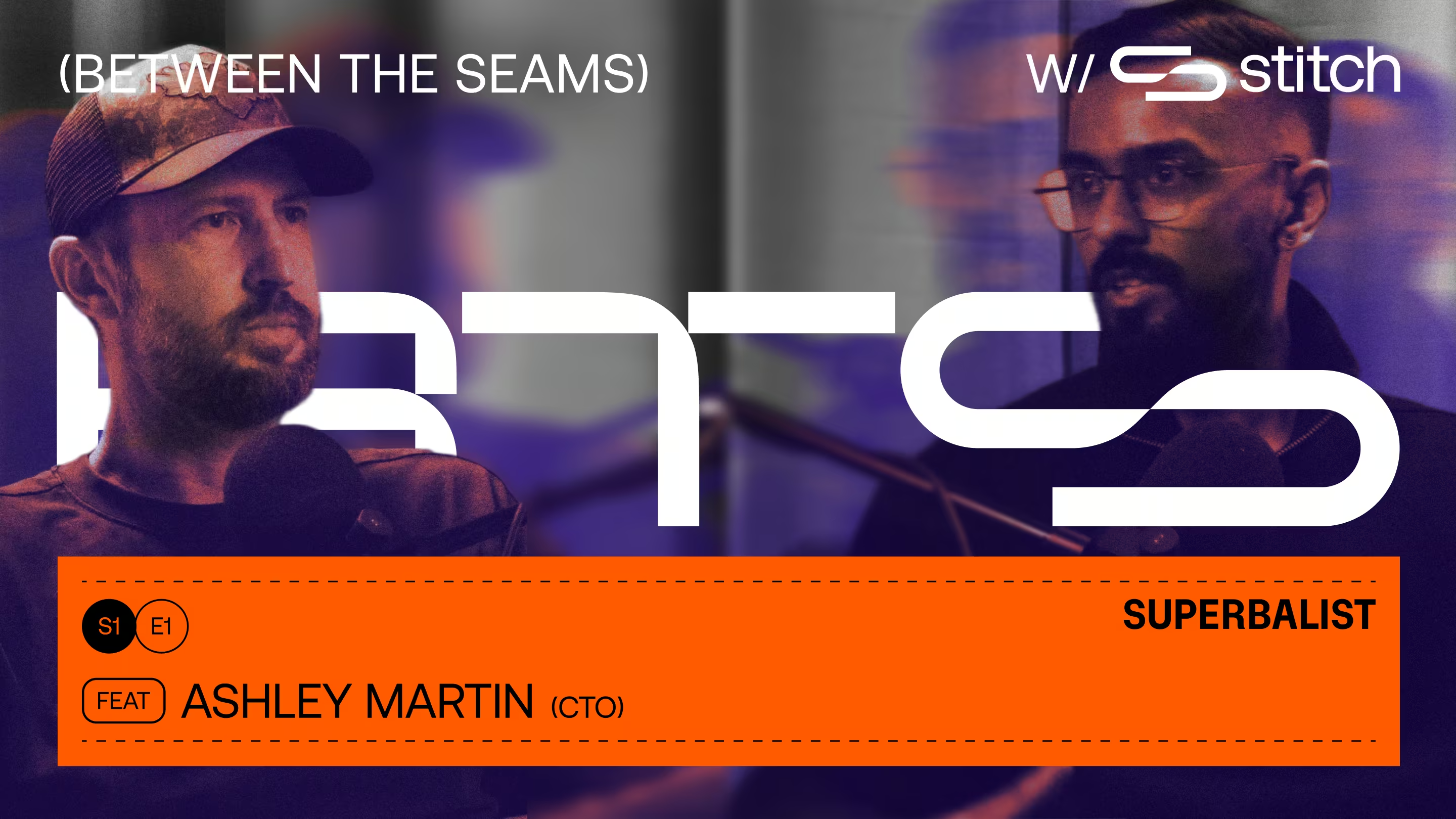
Seven Black Fridays. That's how Ashley Martin, CTO of Superbalist, measures his tenure at one of South Africa's most recognised fashion e-commerce platforms: Each one a stress test.
It's a fitting metaphor for a conversation that kept returning to the same theme: what it actually takes to build and run systems that perform when pressure peaks, and how the tools available to engineering teams are changing that equation faster than almost anyone anticipated.
From AWS to e-commerce: the pull of real impact
Before Superbalist, Ashley spent time at AWS. It was a formative experience, but one that left him feeling removed from the end result of his work.
"At AWS, I learnt a lot there, but I was quite separated from what Ashley does today. How does [what I’m building] land with customers?" he told Priyen. "When I left AWS, I wanted to experience that again."
That desire to see the direct effect of his contribution led him to Superbalist, then part of Takealot, where he found an environment that was already cloud-native and ready to scale. What it needed was someone willing to think carefully about how systems behave under pressure.
The danger of managing by averages
Ashley described a lesson from early in his time at Superbalist, working through a problem with stock cancellations.
When a customer places an order, the system assumes the stock is there. Sometimes it isn't. When Ashley's team looked at cancellation rates as an average, the number was small enough to feel insignificant: it was a decimal-place percentage that was easy to deprioritise – until they flipped the framing.
"The simple exercise of swapping that around and going, 'X number of customers in every 100 orders is experiencing a cancellation'; now that becomes really real," he said.
It's the kind of reframe that sounds obvious in hindsight but requires discipline to apply consistently. For Ashley, it's become a core principle: averages obscure the customers who are actually having a bad day. And if you're building for averages, you're building for no one in particular.
"If you care about the averages, I think then you would have an average score. Keeping at that top percentile means you care about all percentiles equally," Priyen added. It's a harder discipline than it sounds.
This thinking extends across the business. The logistics team delivers to GPS coordinates rather than named addresses, which may sound like a minor detail until you consider how many South African delivery locations don't have a formal street address. Product teams run individual customer interviews, not just aggregate feedback. Small things, pooled together, that add up to a meaningfully different experience.
Building the system that builds the system
The conversation shifted naturally into engineering culture and the arrival of AI-assisted development. Ashley's framing was pragmatic rather than evangelical.
He described four quadrants through which he's thinking about AI at Superbalist: personal productivity, operational intelligence, AI features within the Superbalist product and agentic surfaces. Each quadrant has a different maturity curve, a different risk profile and a different set of questions to answer before you can move confidently.
On the development side, Superbalist has been using inline code completion for a while and has now moved into agentic workflows. But Ashley was careful to distinguish between the excitement of what's possible and the discipline required to deploy it safely.
"We can't have agents going and building things, and there's nothing to evaluate the quality of what they're outputting," he said. The team has had to think hard about where it's safe to experiment, which parts of the codebase are high-stakes enough to require extra rigour, and how to make sure test suites are genuinely robust rather than happy-path coverage dressed up as thoroughness.
The SpaceX analogy came up here, one Ashley acknowledged his team has probably heard more than once: building the factory to build the rockets is the harder, more important challenge than building any individual rocket. The infrastructure that enables fast, safe AI-assisted development is more valuable than any single feature it might produce.
Priyen re-emphasised the overall engineering challenge: "Building the system that builds the system is very important. It's about what are the key things you need in place to make sure that when your code is going from full agent into production, you've got the right gates, the right testing protocols, the right metrics. So that by the time it hits production, you're sure."
For now, humans remain in the loop. Ashley was frank about that. "We're not at the stage yet where we're taking humans out of the loop. I certainly don't have the confidence yet to go and do that."
Velocity as the real prize
What struck Priyen in the conversation was how Ashley frames the AI opportunity: not primarily as a cost-saving measure or a headcount question, but as a velocity play.
Superbalist has always had a small, lean engineering team. The backlog has always been longer than the team's capacity to clear it. AI tools don't change that dynamic, but they do let the team chase more of what matters.
"Being less prescriptive in this world today is an advantage," Ashley said. "It keeps us ready to shift and change as we need to." That flexibility, he argued, is as valuable as any specific capability the tools provide.
Priyen pushed back on the displacement framing: "A lot of people are worried about AI taking jobs. I think it creates a lot of jobs to create these systems, to harness them in the right way. There's nothing off the table; anything is possible. It's just about the harnesses we need to get to that place."
"The ability to self-host hopefully drives some of the pricing in the right way as well," Ashley added, noting that the competitive landscape among AI providers is far from settled. DeepSeek's emergence was a reminder that the field can change overnight.
What's next for Superbalist
Superbalist has moved beyond pure e-commerce, having acquired brick-and-mortar stores. That shift into physical retail brings its own complexity and opens new questions about how online and in-store experiences connect.
Ashley was measured when asked about the road ahead, cards appropriately close to his chest. But on agentic commerce, he was openly curious and openly patient.
"As South Africans we're quite fortunate insofar as we lag behind the rest of the world and we can sort of let them pay the school fees a little bit," he said. "Then make educated decisions."
Given how fast things are moving, that lag is probably measured in weeks rather than years. But the discipline to wait, watch and then move purposefully is itself a kind of competitive advantage.
FAQs
What is Between the Seams?
Between the Seams is a podcast by Stitch that goes behind the scenes with the founders, leaders, builders and investors behind South Africa's most ambitious businesses. Each episode explores how companies are built, how they navigate shifting consumer demands and what real innovation looks like in South Africa and beyond.
Who is Ashley Martin?
Ashley Martin is the CTO of Superbalist, one of South Africa's leading fashion e-commerce platforms. He joined the company when it was part of Takealot and has been there through seven Black Fridays, eventually becoming CTO. Before Superbalist, he worked at AWS.
What does Superbalist use AI for?
Ashley Martin describes four areas: personal productivity across teams, operational intelligence (combining business intelligence with operational data), AI-powered features within the Superbalist product, and agentic surfaces. The engineering team has been using inline code completion for some time and is now exploring agentic workflows, with humans still in the loop at key review stages.
What does "managing by averages" mean and why is it a problem?
Managing by averages means looking at aggregate metrics rather than the individual customer experience behind them. Ashley Martin's example from Superbalist: a stock cancellation rate that looks like a small percentage is actually X customers in every 100 orders having their purchase cancelled. Framing it the second way makes the problem real. Averages can mask issues that are significant at the level of individual customers.
Is Superbalist expanding beyond e-commerce?
Yes. Superbalist has acquired brick-and-mortar retail stores, moving the business beyond pure e-commerce. Ashley Martin discussed this as part of a broader period of change for the company, alongside its growing focus on agentic commerce.
Listen to more interviews like these