Between the Seams: engineering trust at scale with Ashish Aggarwal
In episode two of Between the Seams, Junaid Dadan sits down with Ashish Aggarwal, Partner at PayPal Ventures and Stitch board member, to explore three global commerce trends: the rise of unified omnichannel data, the embedding of payments in vertical software, and how AI is changing merchant discoverability and customer relationships. Plus: what PayPal Ventures actually looks for in a founder.
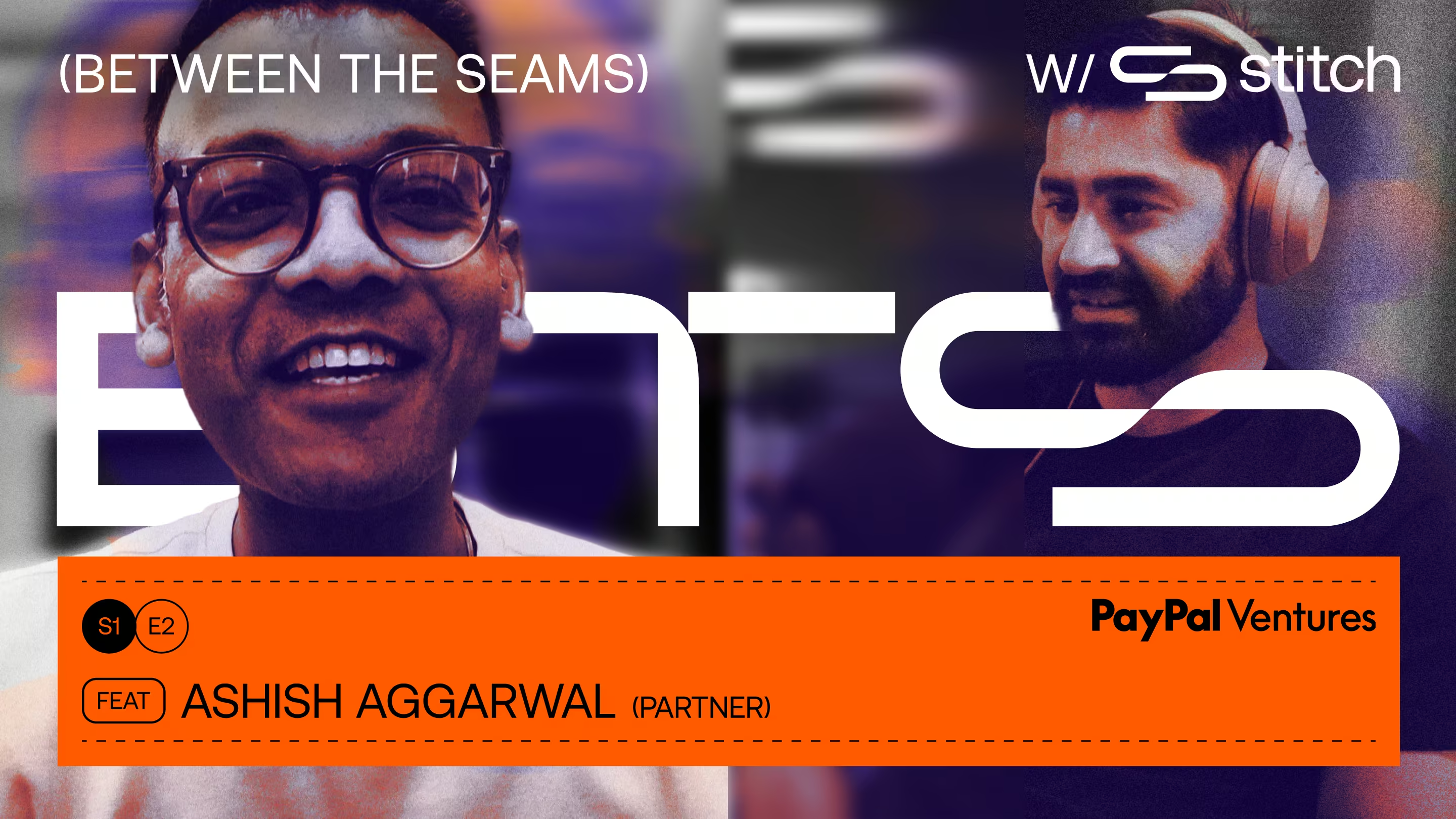
In the second episode of Between the Seams, Stitch President and Co-founder Junaid Dadan sits down with Ashish Aggarwal, Partner at PayPal Ventures, an investor in Stitch since our Series A. With a portfolio of 85+ companies globally, Ashish provides a bird's-eye view of how South Africa compares to emerging giants like India and the established markets of Europe.
Four years into his investment in Stitch, Ashish Aggarwal has a sharper view of the South African market than most global investors. His verdict: South Africa keeps outperforming expectations.
"SA has year after year positively surprised on their resilience," he told Junaid. With GDP growth trending upward, inflation at decadal lows and the rand appreciating against the dollar in a period where most emerging market currencies have moved the other way, the macroeconomic backdrop has shifted meaningfully.
For anyone still dismissing the market on size grounds, Aggarwal pointed out that the financial services sector here is disproportionately deep relative to comparable markets, and e-commerce is still in the early stages of its adoption curve, growing at 20 to 30% a year from an under 10% penetration base.
That combination of depth and headroom shapes what follows.
Three trends reshaping commerce globally
Aggarwal spent the bulk of the conversation walking through three trends he's watching across PayPal Ventures' 85+ company portfolio spanning 20 countries. Each one has significant implications for merchants and payments businesses in South Africa.
1. Omnichannel data as the real differentiator
This isn't new, but its urgency is. Consumers have never thought of themselves as online shoppers or in-store shoppers. They think about merchants and brands. A customer who browses a retailer's website and then walks into a store expects to be recognised as the same person, but in most cases, they aren't. The reality is that there are two separate systems, two separate data streams and no unified view of behaviour.
Aggarwal pointed to Adyen's public reporting as evidence of how this is playing out at scale. Their unified commerce business, which brings online and in-person payments onto a single stack, is growing faster than their pure e-commerce business because merchants are actively asking for it.
"Data is the new oil," he said. "For a merchant to really get a grasp of who their consumers are, that has always been a question, but now it's becoming table stakes."
For Junaid, the Adyen parallel resonate. "Adyen is a company that Stitch and many players in the payment space trying to do omnichannel take a lot of inspiration from. What we're trying to bring to the South African and African market is a lot of what they've built in Europe." The organic development of the product, owning all of your own software, building it all in-house – those are core principles at Stitch too, he said.
The second-order implications matter more than the first-order ones. Accepting a payment is table stakes. Understanding that the same customer who ordered online last Tuesday also came in-store on Saturday, knowing what they bought across both occasions, and being able to act on that information is where the real commercial value sits. In a world where AI agents are increasingly intermediating the relationship between merchants and consumers, merchants who don't own that data layer are exposed.
"Unless you have that one-to-one mapping of your consumers, it's meaningless," Aggarwal said. "You can do as much work on the surface layer, but unless you have your data feeding into that layer, it's just not going to happen."
On the question of why Adyen has managed to become the default for large European retailers despite operating in a heavily banked, competitive market, Aggarwal highlighted their focus and patience. They built everything organically, kept their heads down through the capital abundance of 2021 and 2022 when others were distracted, and let compounding do its work. "They've been at it for 20 years. Think about the compounding that happens technically and commercially when you've been at it for that period of time."
2. Embedded payments in vertical software
The second trend is less visible but potentially as significant. A large and growing portion of commerce doesn't happen through e-commerce stores or consumer apps. It happens inside the operational software that businesses run on: dealership management systems, restaurant POS platforms, healthcare booking tools. These verticals are digitising, and payments are being embedded directly into the software rather than bolted on separately.
Aggarwal described two portfolio companies operating in this space. One in Germany works with automotive dealerships, replacing paper-based payment processes with an integrated system that tracks every incremental charge through the purchase and servicing journey and creates a full audit trail for manufacturers and dealers. Another in Amsterdam works with mid-market restaurants, embedding payments inside the software they already use so that end-of-day reconciliation happens automatically rather than requiring a manager to stay an hour after close.
The Toast analogy is instructive here. Toast built trust with restaurant owners through table management and booking tools, then extended into payments because they already understood the business. Once embedded, the relationship deepens: loyalty programmes, personalised offers, kitchen management. A classic land-and-expand story built on software stickiness rather than payment pricing.
"The way I've seen this pattern play out is: you have a large vertical that's quite undigitized, very traditional. Companies like Toast see a gap and say, let's produce a piece of software that digitizes the management of this business, all-in-one. Like what Shopify did for e-commerce, Toast does for restaurants. That pattern hasn't yet played out in most verticals in South Africa. That's probably one of the areas where we'll see a lot of e-commerce growth over the next five to ten years, from these verticalized solutions," said Junaid.
3. AI and the coming shift in discoverability
The third trend connects to something most merchants haven't fully confronted yet. If a consumer asks ChatGPT to recommend somewhere to go for dinner, or searches for a product using a natural language description rather than structured keywords, the merchants who don't show up in those results are invisible.
Aggarwal framed this as the lowest-hanging fruit of the AI moment: basic discoverability, equivalent to what Google Maps represented a decade ago. "Were you in the consideration set? If not, you should figure something out."
Beyond discoverability, there's a structural challenge for inventory and merchandising. Natural language searches don't map neatly to the size, colour and category filters that most inventory systems are built around. A consumer searching for "the white T-shirt Tom Cruise wore in Top Gun" isn't going to type a size or a brand name. Merchants who can attach unstructured, AI-generated tags to their product catalogues will have an advantage as search behaviour shifts.
The longer-horizon question is about relationships. In a world where AI surfaces increasingly sit between consumers and merchants, the businesses that will be hardest to disintermediate are the ones with genuine customer loyalty and deep behavioural data. American Express customer service came up as a reference point: in a market with multiple card providers, the ones with strong customer relationships retain them regardless of what surrounds them.
"Just because it's cool to buy through ChatGPT doesn't mean the consumer will go there to buy," Aggarwal said. "As long as you remain true and honest to your value proposition, you should be in a good position."
Junaid drew a longer historical arc: "First shift in retail was, now there's something called ‘online’, then apps, then social commerce, then verticalization. Each time, the people who moved quickly gained share. These shifts don't come about every day: every five to ten years you get a big wave. If you're building in this space now, you really need to take advantage of that."
The observation that OpenAI shut down its in-chat checkout feature just weeks after launching it reinforced this: the shape of agentic commerce is still very much open. No one has the definitive answer yet, which means this is still a moment where early movers can shape the outcome rather than react to it.
BNPL as a trust mechanism, not just an affordability tool
Most conversations about Buy Now, Pay Later start with affordability, but Ashish Aggarwal's framing went somewhere more interesting.
Drawing on PayPal Ventures' experience across markets including India, the Middle East and South Africa, he argued that the structural driver of BNPL adoption in emerging markets has less to do with whether consumers can afford something and more to do with whether they trust the merchant enough to pay for it upfront.
In India, cash on delivery used to account for more than half of all e-commerce transactions. Consumers wanted to receive a product before committing fully to paying for it. BNPL offered a middle path: pay a portion now, receive the goods, settle the rest once you're comfortable. "You feel you have control," as Aggarwal put it. The share of cash on delivery transactions has since fallen dramatically, and BNPL was part of what made that shift possible.
Junaid agreed with that angle. "Everyone always thinks about BNPL from an affordability perspective. But it's a way for a consumer, even if they have the money, to limit their exposure to a merchant. If they don't get fulfilment, they have less exposure."
Aggarwal's broader point was that the conditions driving BNPL adoption look quite similar across markets that seem, on the surface, very different. Japan, UAE, Saudi Arabia and South Africa all have strong BNPL uptake, but for distinct reasons. Japan was about convenience. The Gulf markets were a combination of trust and convenience. South Africa sits closer to the India end of the spectrum, where many consumers are creditworthy but lack access to formal credit products, and where trust in digital commerce is still being built.
What connects these markets is a structural gap: consumers who want to buy, but who have historically lacked an option that felt safe and accessible. "In markets like India and SA, you actually didn't have an option, no matter how much you wanted one," Aggarwal said. "That's where the inherent structural and growing demand for flexible consumer credit comes from."
For merchants, the implication is that BNPL isn't just a conversion tool at the margin. In markets where that trust deficit exists, offering it is part of how you bring a broader customer base into digital commerce in the first place. Local players have a meaningful advantage here, because the right product design is deeply contextual. A global BNPL product built for a US consumer base is unlikely to be calibrated correctly for a South African one. "The consumer's behaviour and association with money is very local," Aggarwal noted. "Local players have an inherent advantage compared to global platforms for whom it's just another new market."
FAQs
Who is Ashish Aggarwal?
Ashish Aggarwal is a Partner at PayPal Ventures, the corporate venture capital arm of PayPal. He leads the firm's investment activity outside the Americas, covering Europe, the Middle East, Africa and Asia. He has been on the Stitch board since the company's Series A in December 2021. Before PayPal Ventures, he spent five years at Deutsche Bank covering European payments mergers and acquisitions.
What is PayPal Ventures?
PayPal Ventures is PayPal's corporate venture capital programme, now in its tenth year. It has a portfolio of over 85 companies across 20 countries, backing fintech and commerce companies at Series A and Series B stages in both B2B and B2C categories.
What does Ashish Aggarwal think about the South African market?
Despite common concerns about market size, Aggarwal has been positively surprised by South Africa's resilience over four years as a Stitch investor. He points to GDP growth, inflation at decadal lows and rand appreciation against the dollar as positive macro signals. He acknowledges that e-commerce penetration remains under 10% of all sales, but is growing at 20 to 30% annually, which he sees as a significant long-term opportunity.
Why does omnichannel matter so much for merchants?
Consumers don't think in channels. They think about brands and merchants. When online and in-store data sit in separate systems, merchants lose the ability to understand their customers' full behaviour and act on it. Aggarwal argues that as AI agents become a more prominent layer between merchants and consumers, merchants who lack a unified data view will be at greater risk of being disintermediated.
What is vertical software and why does it matter for payments?
Vertical software refers to platforms built specifically for a particular industry, such as restaurant management tools like Toast or automotive dealership systems. These platforms digitise the core operations of those businesses and, once trusted by operators, become natural channels for embedding payments and financial services. Aggarwal sees the verticalization of industry software as an underdeveloped opportunity in South Africa, with significant growth potential over the next decade.
How should SA merchants be thinking about AI right now?
Aggarwal's near-term advice is to focus on discoverability: making sure your business shows up when consumers search using AI tools like ChatGPT. Beyond that, he encourages merchants to think about how they tag and structure product data to support natural language search, and to focus on building genuine customer relationships and loyalty, which will be the hardest thing for AI intermediaries to displace.
Get more insights from Ashish